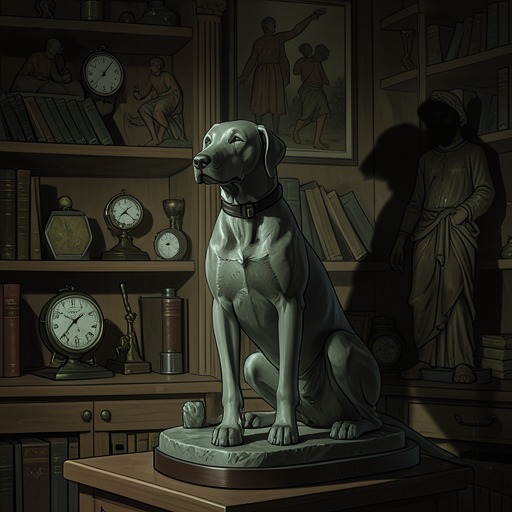
Legend of the Carpathian Hound
The Mystery of The Invisible DogThe Legend of the Carpathian Hound is a supernatural folk tale Charles Niedland relates while explaining the subject of his brother Edward Niedland’s sculpture. It describes a village haunted by a dog said to be the ghost of a dead nobleman: a story in which the hunger imposed on animals returns as the nobleman’s own endless torment. The tale’s uncertain truth is part of its force, while its details connect directly to the crystal-and-gold artwork missing from Fenton Prentice’s collection.
The Legend and Its Setting
Charles Niedland presents the account as a story from two centuries earlier, set in a village in the Carpathian Mountains. Its inhabitants were said to be superstitious, and their alleged haunting belongs to a landscape associated in the conversation with other supernatural traditions. Jupiter Jones notes the region’s identification with Transylvania and its connection to the story of Dracula; Charles distinguishes this dog from a vampire or werewolf. In his account, the creature’s origin is specifically a local curse, not one of those familiar kinds of monster.
The legend’s supernatural explanation remains qualified rather than confirmed. Charles first describes the dog as something that probably existed only in the minds of superstitious people, then recounts what villagers believed about it. That movement—from skeptical framing to detailed tradition—lets the story function both as folklore and as an explanation of the sculpture’s imagery. The account does not establish that the events happened; it preserves them as a tale told about the village.
The Nobleman’s Curse
According to the story, the dog was believed to be the ghost of a nobleman who avidly hunted and bred a pack of savage dogs, said to be part wolf. He kept the animals half-starved to sharpen them for hunting. One escaped and killed a child. When the child’s father demanded that the dogs be destroyed, the nobleman refused and offered him only a few coins. The father, enraged, threw a stone at the nobleman; the blow killed him, though not immediately.
Before dying, the nobleman cursed the village and vowed to return and haunt it. The curse gives the legend its chain of consequences: the nobleman’s refusal to accept responsibility for the child’s death is followed by his own death and a threat directed at the whole community. The story does not merely introduce a frightening animal; it makes the haunting the continuation of a conflict over the harm caused by the nobleman’s dogs and his dismissive response to that harm.
The Hungry Hound and the Abandoned Village
The nobleman is said to return as an enormous, gaunt hound, possibly part wolf. Although his hunting pack has been destroyed, one creature roams the village on dark nights, howling and whining. Its visible thinness recalls the hunger the nobleman had inflicted on his dogs. Villagers try leaving food for it, but it cannot or will not eat. The attempted kindness therefore changes nothing: the animal remains hungry, and the curse cannot be relieved by the people who encounter it.
Charles describes this as a grim form of justice. If the dog is indeed the nobleman, then the curse comes true, but its punishment mirrors the conduct that preceded it: the former owner of hungry dogs is himself condemned to hunger. In time, the villagers move away. The legend leaves the hound in an abandoned ruin, where it may still prowl. That ending does not report the curse as verified history; it closes the tale on the possibility that the creature persists after the human community has disappeared.
From Folklore to Sculpture
The legend is also the subject of Edward Niedland’s Carpathian Hound, a sculpture made especially for Fenton Prentice. Edward was a sculptor rather than a painter, working in glass and crystal, sometimes combining crystal with metals. The piece had been finished a month earlier but had not yet been delivered: Edward intended to include it in a show of newer work at the Mailer Gallery, and Fenton had agreed to let him exhibit it. Its disappearance turns the old tale into the subject of a present-day theft investigation.
The material and finish translate specific elements of the legend into an artwork. Charles explains that Edward shaped very hot, nearly liquid glass or crystal, reheating and reshaping it as it cooled, then finishing the form by grinding, buffing, and polishing it with acid. The completed hound was crystal and gold: gold rimmed its eyes, and golden froth marked its jowls, recalling the legend’s image of a ghost dog with glowing eyes. The sculpture thus carries the story not only in its title and animal form but in the details of its surface.
The tale’s hunger and haunting give the missing object a significance beyond its value as a work by a gifted young sculptor. Fenton calls it a remarkable piece, and Charles’s account links its crafted appearance to the village’s imagined supernatural history. The legend remains unproven, but its imagery has been made tangible in Edward’s crystal hound—a representation of the curse that can itself be stolen and sought.